Products
SentimenTrader Trading Tools
‍
Backtest Engine
My Trading Toolkit
Correlation Analysis
Seasonality
Market Prediction
Indicators & Data API
‍
Proprietary Indicators & Charts
Market Data API
Strategies & Scanner
‍
50+ Trading Strategies
Smart Stock Scanner
Smart Option Scanner
Research Reports
‍
Research Solutions
Reports Library
Free Resources
Simple Backtest Calculator
Simple Seasonality Calculator
The Kelly Criterion Calculator
Sentiment Geo Map
Public Research Reports
Education
Sentiment Indicators
Technical Indicators
Pricing
Company
About
In the News
Testimonials
Client Success Stories
Contact
Log inLoginSign up
< BACK TO ALL REPORTS

Options traders pull back

Jason Goepfert
2020-10-26
Last week, the smallest of options traders pulled back on their speculative activity. Call buying was less prevalent, but over the past 10 weeks, it still rivals the most aggressive behavior in 20 years.

We've been checking regularly on the behavior of options traders over the past couple of months because their activity had been speculative to a record degree.

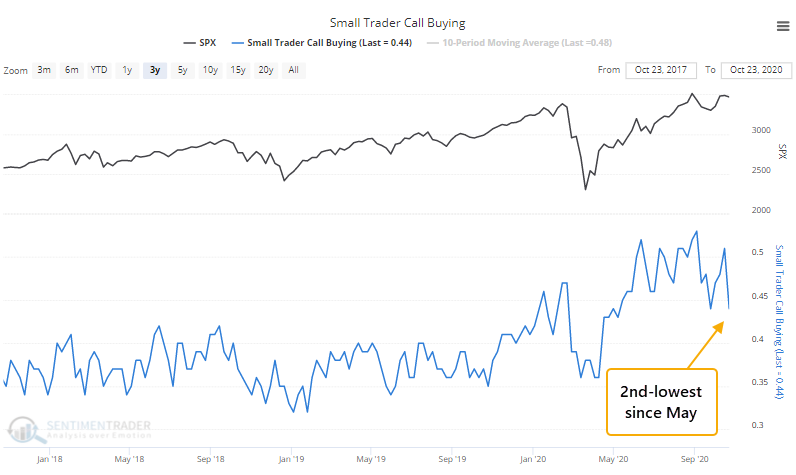
Last week, they became a bit less aggressive. The smallest of traders, those buying or selling 10 contracts or fewer at a time, spent 44% of their volume buying call options to open. That's down from over 50% the prior week and is the 2nd-lowest percentage since May.
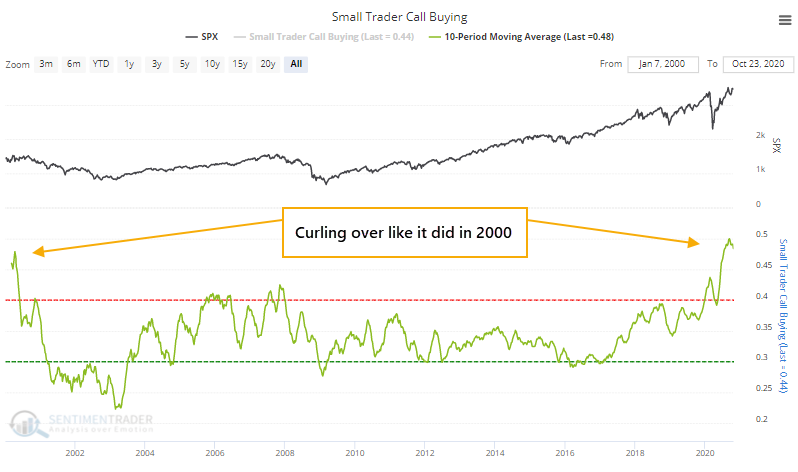
Because they've been so aggressive for so long, the 10-week average hit a record high and is now curling over.
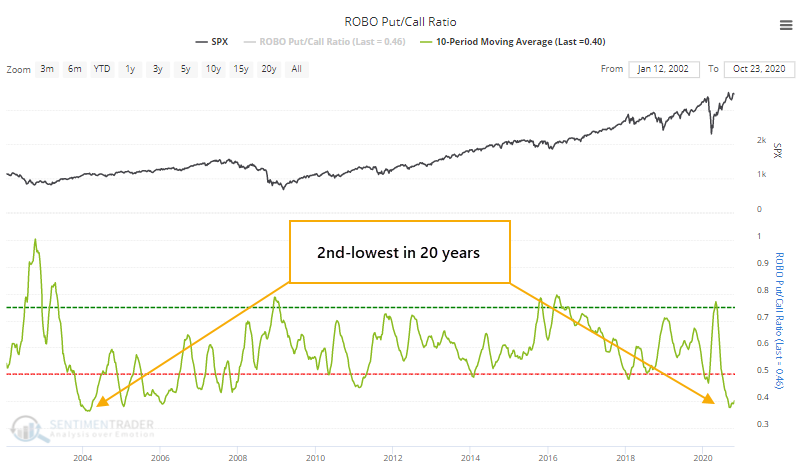
They hadn't been buying many protective puts as hedges, either, so the ROBO Put/Call Ratio neared its lowest level in 20 years and is also curling on a 10-week moving average basis.
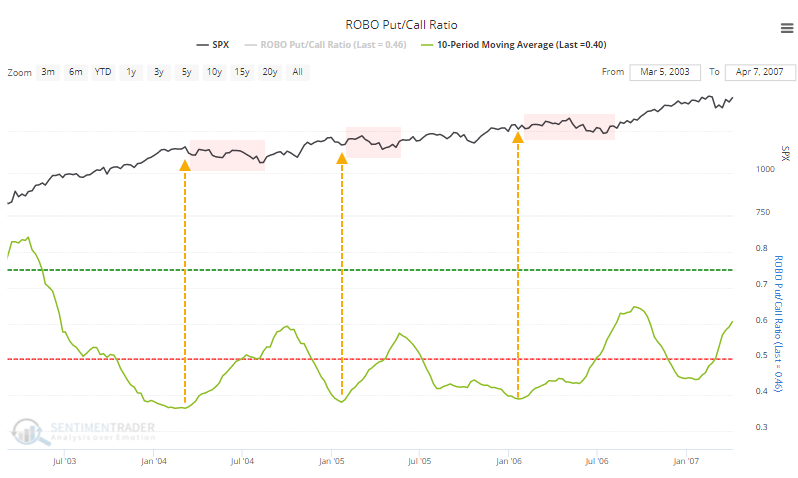
When this ratio dropped below 0.4 and curled higher between 2004-06, stocks went into a holding pattern.
Because they'd been paying so much for call option premiums, and not much for puts, the Put/Call Premium also dropped to a very low level and has since started to move higher. The Backtest Engine shows mixed forward returns after the other times in the past decade when this happened.
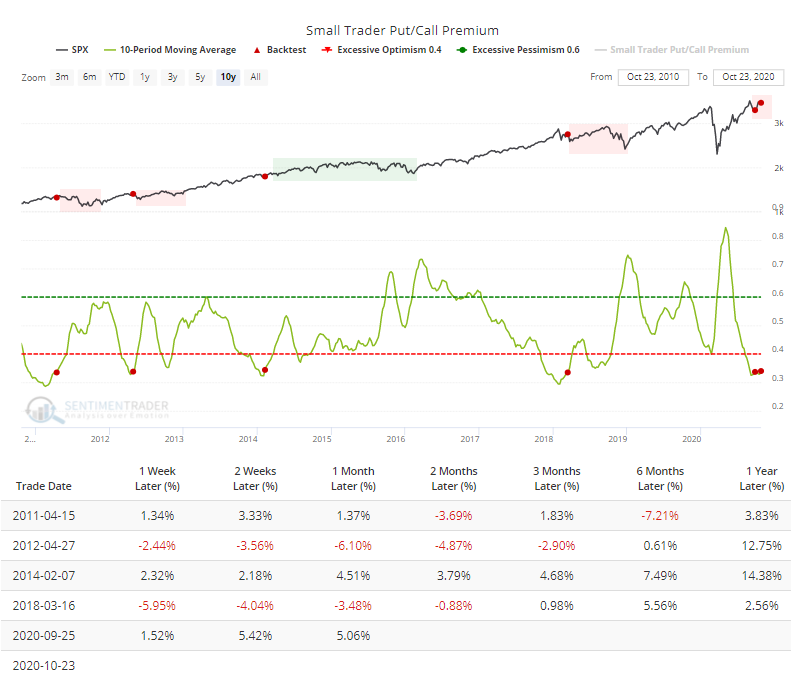
Stocks sold off in 2011, 2012, and 2018, but in 2014, the S&P 500 managed to climb for months on end. Most of those gains were eventually given back temporarily during late 2015 - early 2016, but that's little solace to those who sold too early.

The average started to curl up last month, too, and stocks have rebounded strongly since then.

Overall, there was little that happened last week to change the suggestions from the options market - trading behavior still rivals the most speculative periods in 20 years. It has eased back a bit from the height of the mania in late August, but there isn't much here that could be considered a positive for stocks.

PRODUCTS
SentimenTrader
Trading Tools
Indicators & Data API
‍
Strategies & Scanner
‍
Research Reports
FREE
RESOUrCES
Simple Backtest
Calculator
Simple Seasonality
Calculator
The Kelly Criterion
Calculator
Sentiment Geo Map
‍
Public Research Reports
‍
Education
Sentiment Indicators
‍
Technical Indicators
‍
Pricing
Bundle pricing
‍
FAQ
‍
Announcements
‍
COMPANY
‍
About
‍
In the News
‍
Testimonials
‍
Client Success Stories
CONTACT
‍
General Inquiries
‍
Media Inquiries
‍
Financial Professionals Inquiries
‍
© 2026 Sundial Capital Research Inc. All rights reserved.
Setsail Marketing
TermsPrivacyAffiliate Program
Risk Disclosure: The information and tools provided are for research and analytical purposes only and are not intended as investment advice. Market analysis involves uncertainty, and outcomes may differ from expectations. Users should conduct their own due diligence and consider their individual circumstances before making any financial decisions. Past performance is not necessarily indicative of future results.

Hypothetical Performance Disclosure: Hypothetical performance results have many inherent limitations, some of which are described below. No representation is being made that any account will or is likely to achieve profits or losses similar to those shown; in fact, there are frequently sharp differences between hypothetical performance results and the actual results subsequently achieved by any particular trading program. One of the limitations of hypothetical performance results is that they are generally prepared with the benefit of hindsight. In addition, hypothetical trading does not involve financial risk, and no hypothetical trading record can completely account for the impact of financial risk of actual trading. for example, the ability to withstand losses or to adhere to a particular trading program in spite of trading losses are material points which can also adversely affect actual trading results. There are numerous other factors related to the markets in general or to the implementation of any specific trading program which cannot be fully accounted for in the preparation of hypothetical performance results and all which can adversely affect trading results.

Testimonial Disclosure: Testimonials appearing on this website may not be representative of other clients or customers and is not a guarantee of future performance or success.