Products
SentimenTrader Trading Tools
‍
Backtest Engine
My Trading Toolkit
Correlation Analysis
Seasonality
Market Prediction
Indicators & Data API
‍
Proprietary Indicators & Charts
Market Data API
Strategies & Scanner
‍
50+ Trading Strategies
Smart Stock Scanner
Smart Option Scanner
Research Reports
‍
Research Solutions
Reports Library
Free Resources
Simple Backtest Calculator
Simple Seasonality Calculator
The Kelly Criterion Calculator
Sentiment Geo Map
Public Research Reports
Education
Sentiment Indicators
Technical Indicators
Pricing
Company
About
In the News
Testimonials
Client Success Stories
Contact
Log inLoginSign up
< BACK TO ALL REPORTS

Percentage of Members Outperforming the S&P 500 Index

Dean Christians
2021-06-29
The percentage of members outperforming the S&P 500 index has fallen to one of the lowest levels since 1927. Let's assess the forward return outlook for the S&P 500.

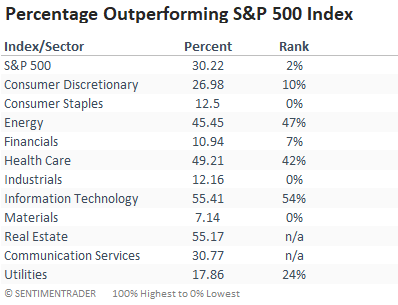
The wild swings in the percentage of members outperforming the S&P 500 index continue with the indicator falling to a historically low level for the second time in less than a year. According to our calculation, only 30.22% of S&P 500 stocks outperformed the Index on a rolling 21-day basis as of 6/28/21. If I compare that level to all other values since 1927, it returns a rank in the 2nd percentile. If we look at sector levels, one can see that the percentile ranks for staples, industrials, and materials reside around the lowest levels in history. Interestingly, the energy sector looks good on a relative basis. The sector ranks started in 1952. 

The sector table provides a clear picture of the short-term performance disparity between growth and value-oriented groups.

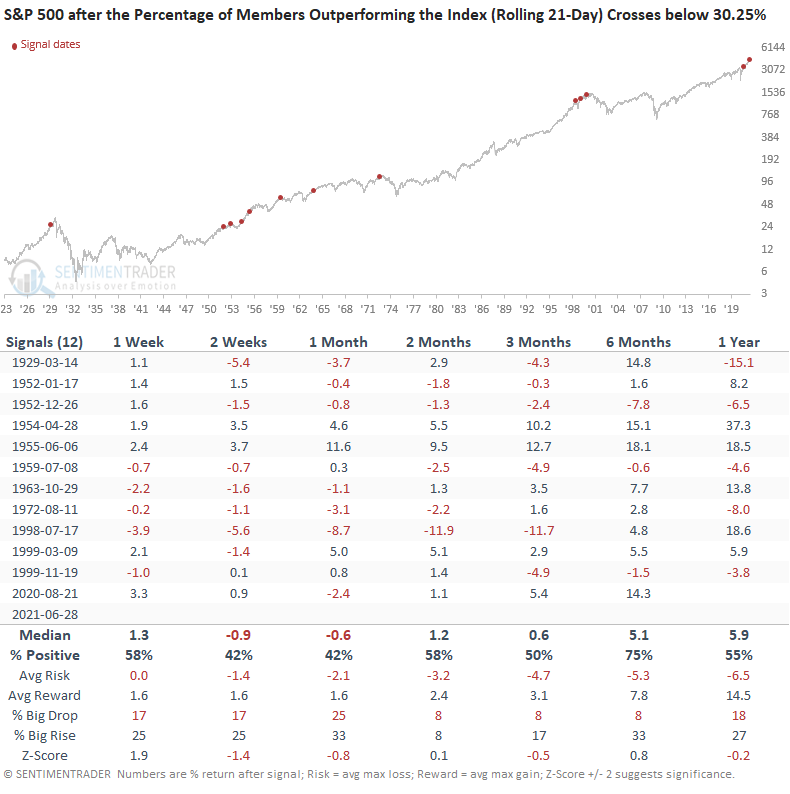
Let's conduct a study to assess the forward return outlook for the S&P 500 when the percentage of members outperforming the index falls below 30.25%. I will also require the index to be within 1% of a 252-day high and include a reset condition whereby the indicator has to cross back above 50% for another signal to occur. The reset condition screens out duplicate signals. 
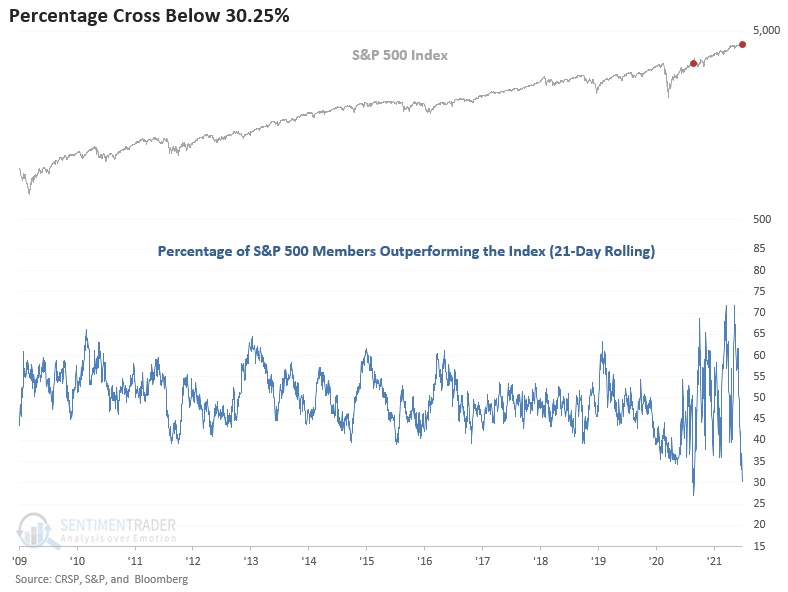
CURRENT DAY CHART

The last time the indicator fell to a level around the current reading, the S&P 500 rallied for an additional eight trading days before correcting by 9.6% on a closing basis in September 2020.
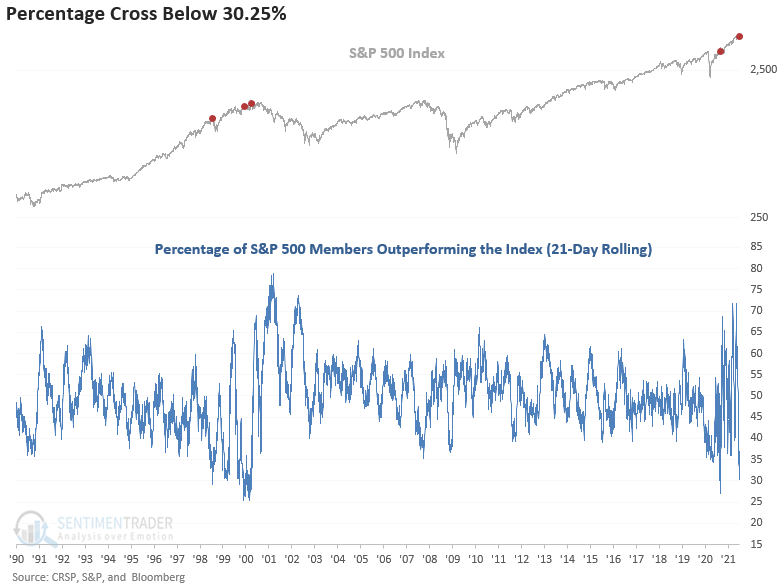
SINCE 1990 CHART

The tail-end of the Dotcom bubble provides the most recent analog to the current-day swings in the indicator.
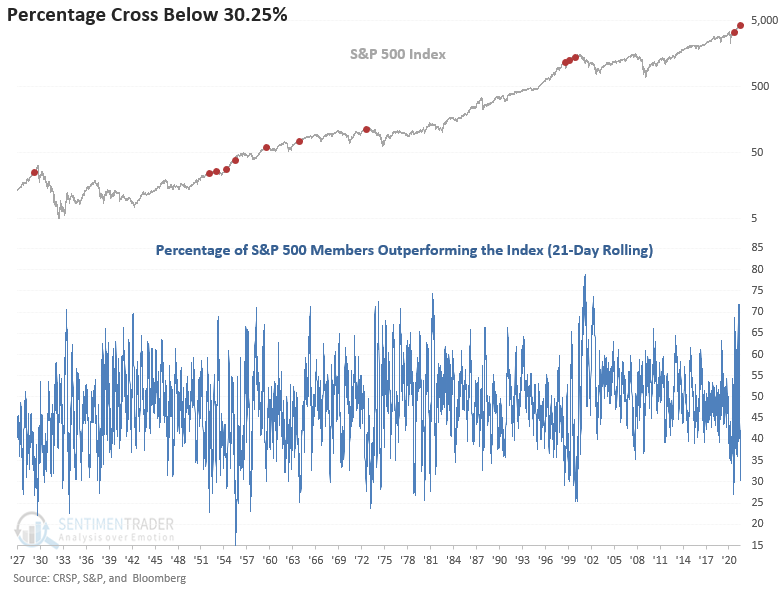
HISTORICAL CHART
HOW THE SIGNALS PERFORMED

With only 12 signals since 1927, the level of members outperforming the index is historic. The returns in the 2-4 week timeframe are relatively weak, while other periods show somewhat muddled returns. I would also note that some of the signal dates like 1929, 1972, and 1999 are concerning.
As Jason and I have noted in recent notes, participation on a short-term basis is not ideal. However, the market continues to steam ahead. Can the short-term measures catch up to price? That continues to be the million-dollar question.

PRODUCTS
SentimenTrader
Trading Tools
Indicators & Data API
‍
Strategies & Scanner
‍
Research Reports
FREE
RESOUrCES
Simple Backtest
Calculator
Simple Seasonality
Calculator
The Kelly Criterion
Calculator
Sentiment Geo Map
‍
Public Research Reports
‍
Education
Sentiment Indicators
‍
Technical Indicators
‍
Pricing
Bundle pricing
‍
FAQ
‍
Announcements
‍
COMPANY
‍
About
‍
In the News
‍
Testimonials
‍
Client Success Stories
CONTACT
‍
General Inquiries
‍
Media Inquiries
‍
Financial Professionals Inquiries
‍
© 2026 Sundial Capital Research Inc. All rights reserved.
Setsail Marketing
TermsPrivacyAffiliate Program
Risk Disclosure: The information and tools provided are for research and analytical purposes only and are not intended as investment advice. Market analysis involves uncertainty, and outcomes may differ from expectations. Users should conduct their own due diligence and consider their individual circumstances before making any financial decisions. Past performance is not necessarily indicative of future results.

Hypothetical Performance Disclosure: Hypothetical performance results have many inherent limitations, some of which are described below. No representation is being made that any account will or is likely to achieve profits or losses similar to those shown; in fact, there are frequently sharp differences between hypothetical performance results and the actual results subsequently achieved by any particular trading program. One of the limitations of hypothetical performance results is that they are generally prepared with the benefit of hindsight. In addition, hypothetical trading does not involve financial risk, and no hypothetical trading record can completely account for the impact of financial risk of actual trading. for example, the ability to withstand losses or to adhere to a particular trading program in spite of trading losses are material points which can also adversely affect actual trading results. There are numerous other factors related to the markets in general or to the implementation of any specific trading program which cannot be fully accounted for in the preparation of hypothetical performance results and all which can adversely affect trading results.

Testimonial Disclosure: Testimonials appearing on this website may not be representative of other clients or customers and is not a guarantee of future performance or success.