
Recovery in new highs versus lows shows improvement in market environment

Key points:
- On the Nasdaq exchange, securities rising to 52-week highs have outnumbered those falling to 52-week lows
- The same has happened on the NYSE, the first time in weeks for both exchanges
- Similar recoveries led to mostly positive future returns for stocks over the medium-term
For the first time in weeks, highs outnumber lows
We saw last week that 52-week lows among Nasdaq stocks spiked to one of the most egregious levels in decades. Between 25% - 30% of securities on the exchange (depending on the data source) fell to 52-week lows, even when netting out the securities hitting 52-week highs.
This week's rally alleviated some of the worst losses, with traders buying stocks with the worst losses. It was enough to push more stocks to 52-week highs than 52-week lows; the first time in 3 weeks that's been the case.
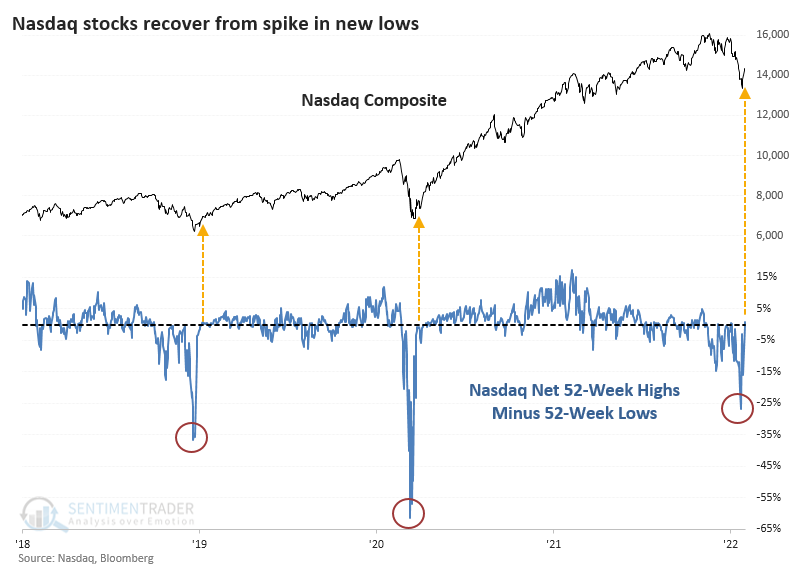
The table below shows every time we went at least 15 days with more 52-week lows than 52-week highs, with the worst point showing at least -25% net new lows.
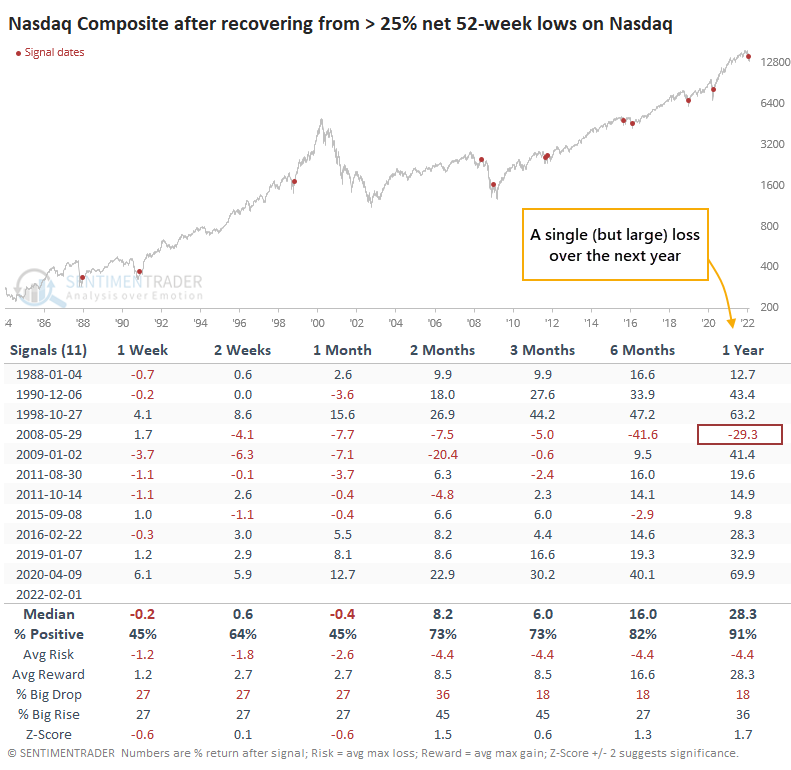
The short-term was volatile, with the Nasdaq Composite gyrating over the next month. Initial reactions to Wednesday's earnings reports will help continue this pattern. By 2 months later, 8 of the 11 signals showed a positive return, improving in the months ahead. Over the next year, all but one (the 2008 financial crisis) showed a gain.
More new highs on the NYSE, too
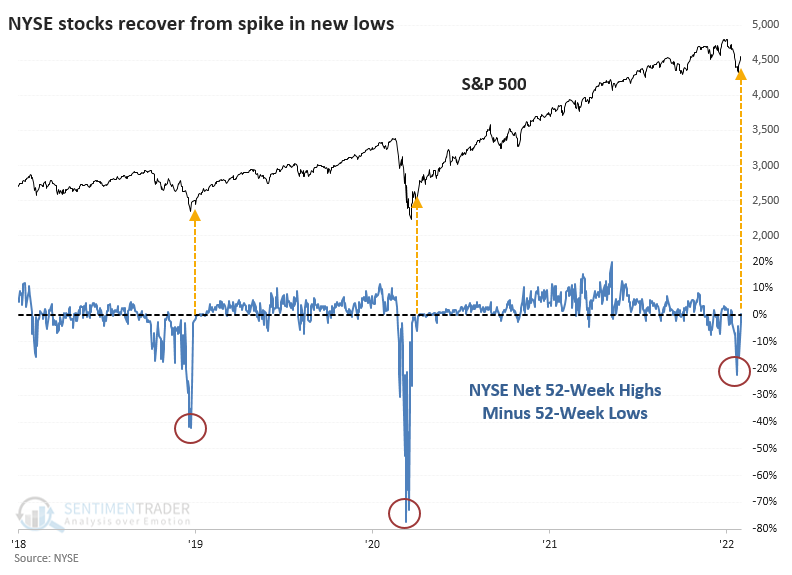
There has been a similar but less extreme pattern on the NYSE. On that exchange, there were more new lows than new highs for 2 straight weeks, exceeding -20% at the worst point. That has since reversed, and there are now more highs than lows.
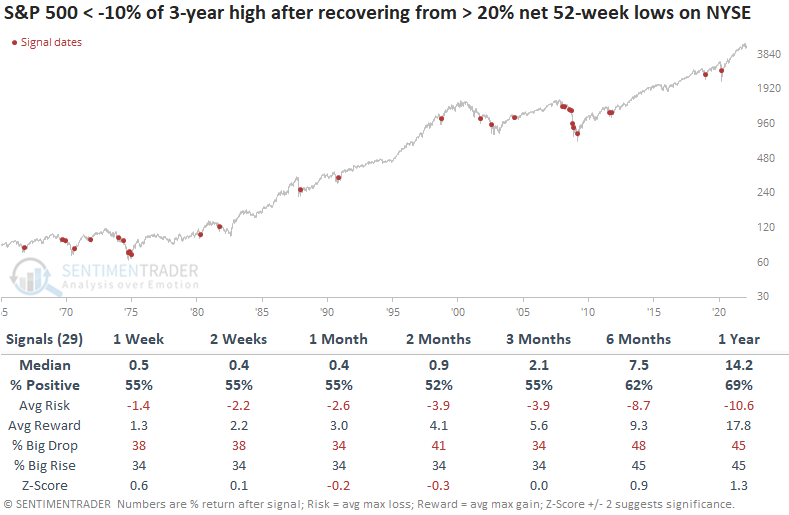
These recoveries' impact on forward return depended somewhat on the losses that stocks suffered during the worst of the losses. The table below shows similar recoveries when the S&P 500 was within 10% of a multi-year high at the time. While short-term returns were nothing special, the S&P did well over the next few months. The sample size is agonizingly tiny, but only one of the signals showed a loss. It was a big one, leading to the 2008 panic.
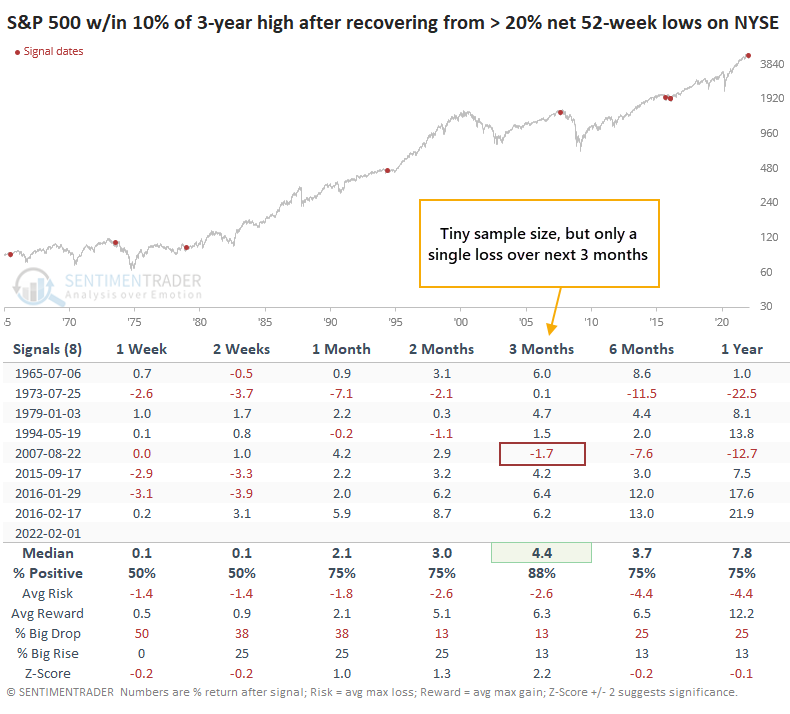
The S&P's returns were better than when these recoveries occurred following more substantial losses. When new highs outnumbered new lows for the first time in weeks, but the S&P was more than 10% from its high at the time, its returns over the next 1-3 months were significantly worse than when the S&P was closer to a high.
What the research tells us...
When we looked at the spike in 52-week lows on the Nasdaq almost 2 weeks ago, we saw that forward returns tended to be consistently positive. Now that stocks have rallied, there has been a recovery in the number of stocks reaching 52-week extremes. This has coincided with some overbought conditions and weak short-term returns, but medium-term returns in the Nasdaq and S&P 500 have mostly been positive after similar recoveries.