Products
SentimenTrader Trading Tools
‍
Backtest Engine
My Trading Toolkit
Correlation Analysis
Seasonality
Market Prediction
Indicators & Data API
‍
Proprietary Indicators & Charts
Market Data API
Strategies & Scanner
‍
50+ Trading Strategies
Smart Stock Scanner
Smart Option Scanner
Research Reports
‍
Research Solutions
Reports Library
Free Resources
Simple Backtest Calculator
Simple Seasonality Calculator
The Kelly Criterion Calculator
Sentiment Geo Map
Public Research Reports
Education
Sentiment Indicators
Technical Indicators
Pricing
Company
About
In the News
Testimonials
Client Success Stories
Contact
Log inLoginSign up
< BACK TO ALL REPORTS

S&P 500 is following through like it did in similar years

Jason Goepfert
2022-03-23
The S&P 500 suffered persistent selling through mid-March. Going back to 1928, there have been more than a dozen years with price action that was highly correlated to 2022. Those years showed a strong tendency to rally into late June. It has already seen 1% rallies on 5 out of the past 6 sessions.

Key points:

  • The S&P 500 has suffered a persistent decline heading into mid-March
  • There have been more than a dozen other years with highly correlated YTD price action to 2022
  • Those precedents consistently preceded gains through June

The most similar years to 2022 tended to bottom about now

The seasonal trends for many equity ETFs and indexes are about to turn from poor or neutral to positive as we enter the spring months. Seasonality alone, especially in stock indexes, is a shaky leg to stand on, but combined with other factors can be a helpful tool.

If we look at the year-to-date loss in the S&P 500 and compare it to other years, we can objectively find periods when poor returns and seasonality combined forces. The chart below shows the S&P in 2022 and an average of 14 other years with more than a +0.7 correlation to this year (on a scale from -1.0 to +1.0).
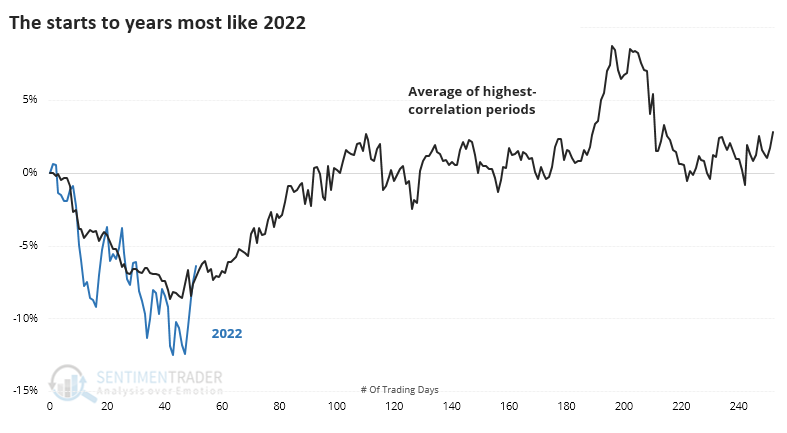
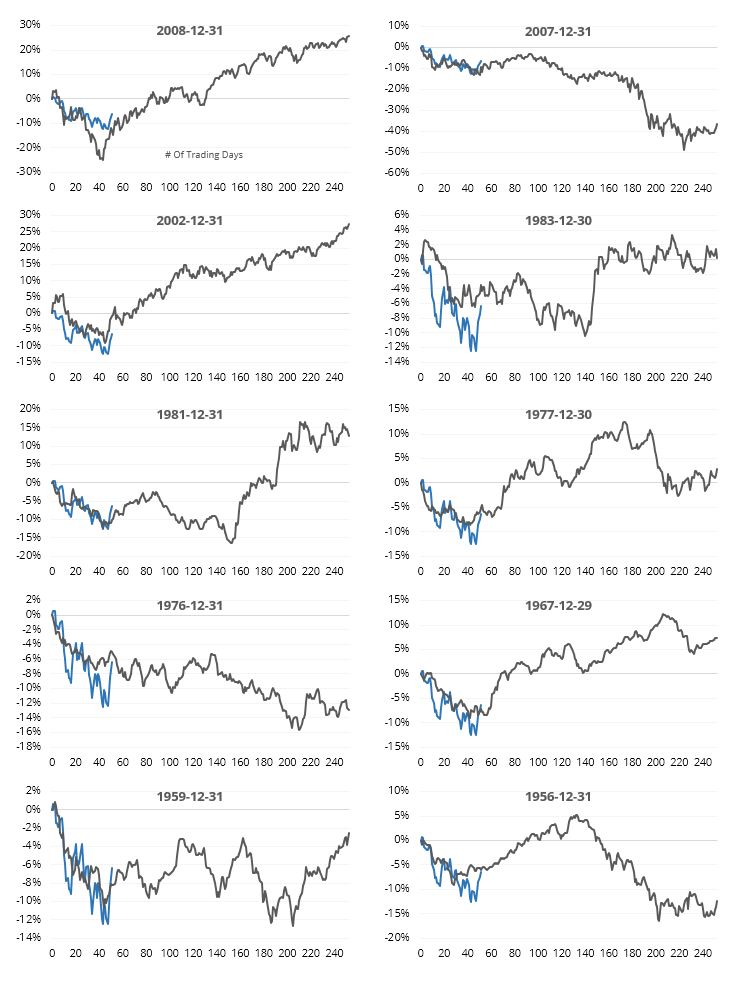
Many of them bottomed right about where we did this year and typically carried higher into early summer. The 10 most recent years with high correlations are below. Only 1976 suffered an immediate rejection and lower lows. The others rallied for about 30 days before failing, if they did at all.
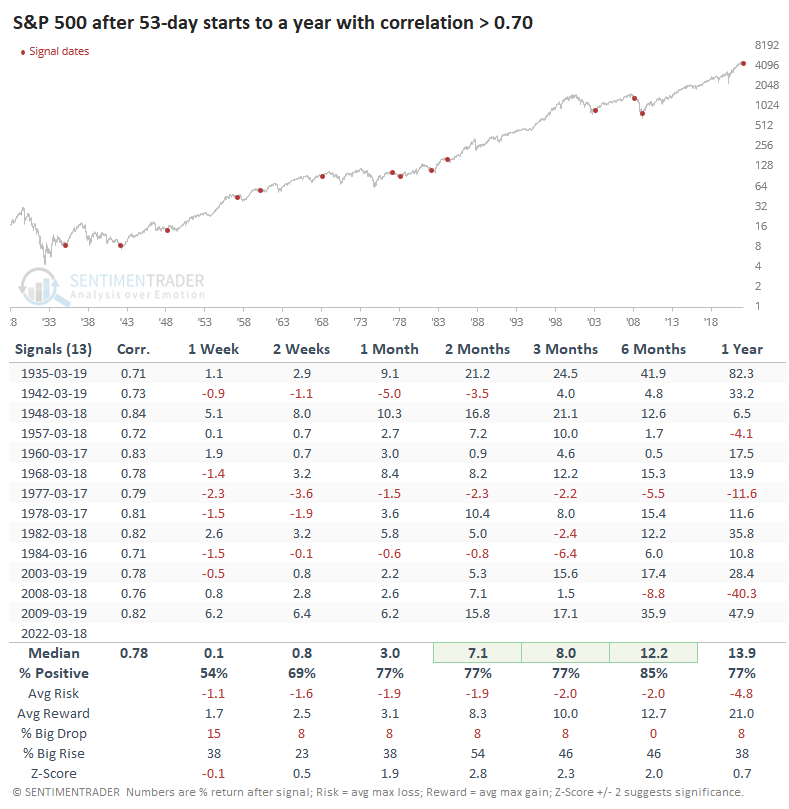
As always, we're more concerned with where we may be going instead of where we've been. The table below shows the S&P's returns after those periods ended. Out of the 13 years with a YTD correlation greater than +0.70, 11 of them showed gains during the next 6 months. Median returns were significantly above random over the next 1-6 months.
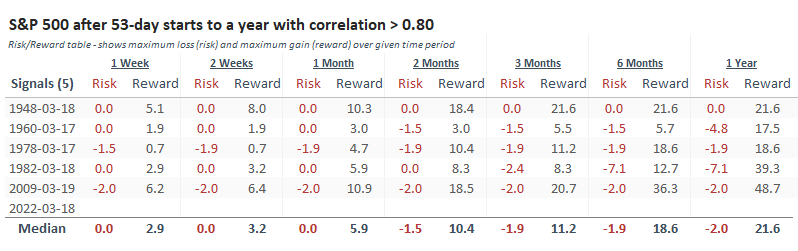
Out of that sample, there were a handful of years with the highest correlations, above +0.80. Those all showed gains in the months ahead.
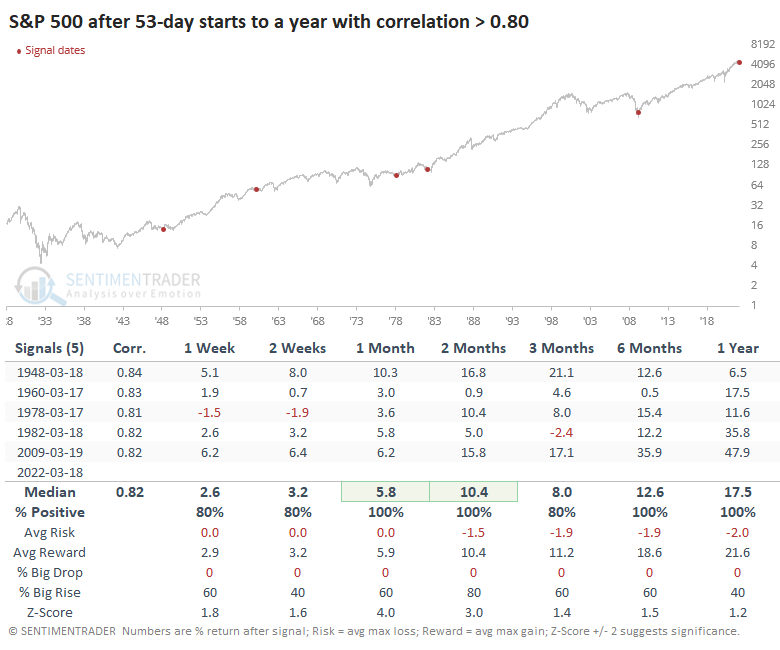
The Risk/Reward Table shows all were heavily skewed to the "reward" side for the next few months. None of the 5 suffered a decline larger than -2.4% at any point within the next 3 months, while all of them enjoyed gains of at least +5.5% at some point by late June. The usual caveats about tiny samples sizes apply.
Already surging

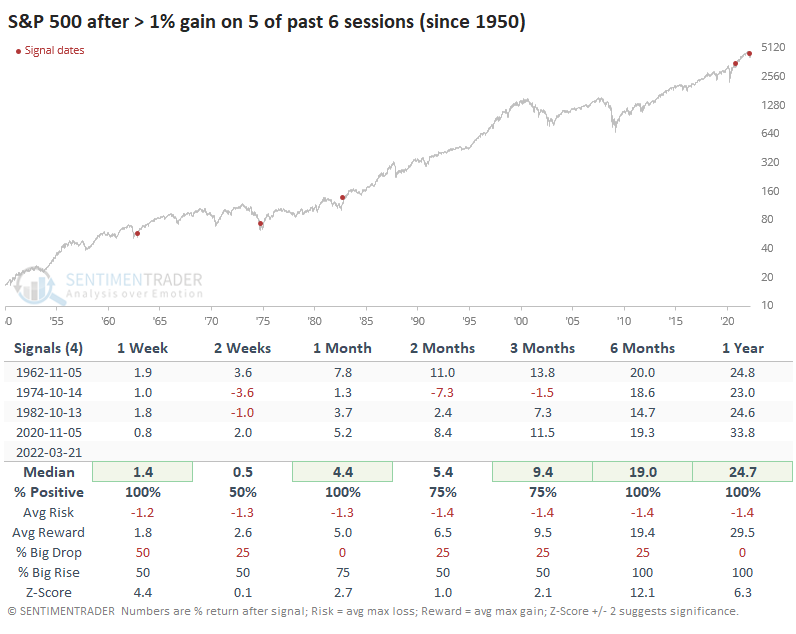
One of the stats making the rounds today is that the S&P 500 has eagerly followed through on recent gains, with 5 of the last 6 sessions showing a gain great than 1%. The last 4 instances all marked major buying thrusts, with further gains of at least 23% over the next year.
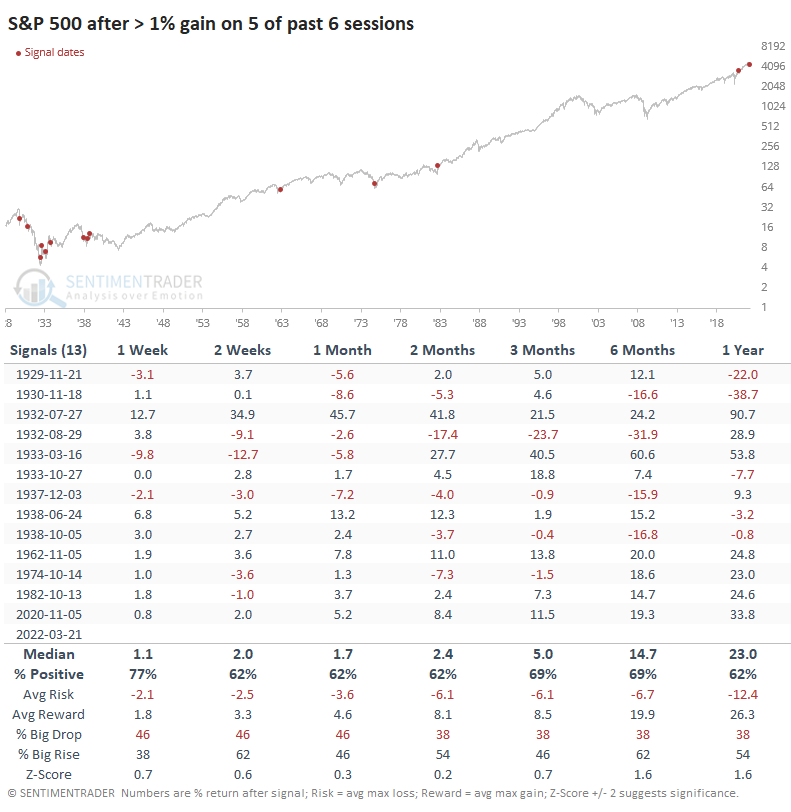
That leaves out the volatile 1930s, however. While a few of them preceded major gains in the months ahead, most of them showed the opposite.
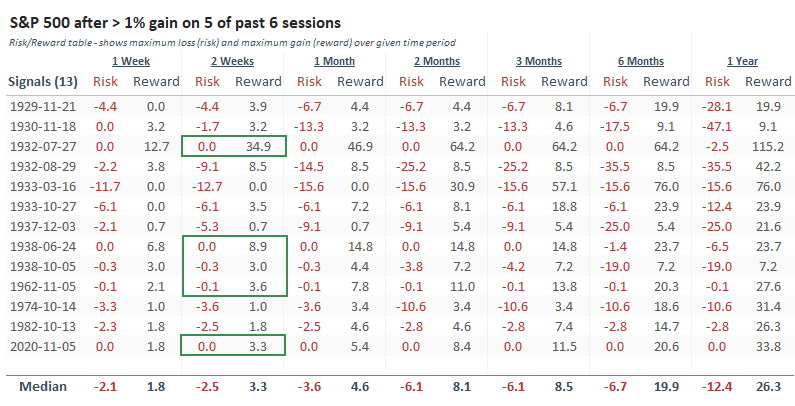
While not at all a perfect indicator, watching the risk/reward over the next couple of weeks was a decent guide for the likelihood of a sustained rally. If buyers continued to push, and sellers stayed away, long-term returns were more robust.
What the research tells us...

We've seen in recent studies that the length, magnitude, and type of decline we've seen since the peak has a high probability of enjoying a multi-week to multi-month rebound. We'll just have to see whether that allows for new highs or ultimately fails. Now, we have an additional tailwind of a positive seasonal bias. The risk/reward continues to point higher over a short- to medium-term time frame.

PRODUCTS
SentimenTrader
Trading Tools
Indicators & Data API
‍
Strategies & Scanner
‍
Research Reports
FREE
RESOUrCES
Simple Backtest
Calculator
Simple Seasonality
Calculator
The Kelly Criterion
Calculator
Sentiment Geo Map
‍
Public Research Reports
‍
Education
Sentiment Indicators
‍
Technical Indicators
‍
Pricing
Bundle pricing
‍
FAQ
‍
Announcements
‍
COMPANY
‍
About
‍
In the News
‍
Testimonials
‍
Client Success Stories
CONTACT
‍
General Inquiries
‍
Media Inquiries
‍
Financial Professionals Inquiries
‍
© 2026 Sundial Capital Research Inc. All rights reserved.
Setsail Marketing
TermsPrivacyAffiliate Program
Risk Disclosure: The information and tools provided are for research and analytical purposes only and are not intended as investment advice. Market analysis involves uncertainty, and outcomes may differ from expectations. Users should conduct their own due diligence and consider their individual circumstances before making any financial decisions. Past performance is not necessarily indicative of future results.

Hypothetical Performance Disclosure: Hypothetical performance results have many inherent limitations, some of which are described below. No representation is being made that any account will or is likely to achieve profits or losses similar to those shown; in fact, there are frequently sharp differences between hypothetical performance results and the actual results subsequently achieved by any particular trading program. One of the limitations of hypothetical performance results is that they are generally prepared with the benefit of hindsight. In addition, hypothetical trading does not involve financial risk, and no hypothetical trading record can completely account for the impact of financial risk of actual trading. for example, the ability to withstand losses or to adhere to a particular trading program in spite of trading losses are material points which can also adversely affect actual trading results. There are numerous other factors related to the markets in general or to the implementation of any specific trading program which cannot be fully accounted for in the preparation of hypothetical performance results and all which can adversely affect trading results.

Testimonial Disclosure: Testimonials appearing on this website may not be representative of other clients or customers and is not a guarantee of future performance or success.