Products
SentimenTrader Trading Tools
‍
Backtest Engine
My Trading Toolkit
Correlation Analysis
Seasonality
Market Prediction
Indicators & Data API
‍
Proprietary Indicators & Charts
Market Data API
Strategies & Scanner
‍
50+ Trading Strategies
Smart Stock Scanner
Smart Option Scanner
Research Reports
‍
Research Solutions
Reports Library
Free Resources
Simple Backtest Calculator
Simple Seasonality Calculator
The Kelly Criterion Calculator
Sentiment Geo Map
Public Research Reports
Education
Sentiment Indicators
Technical Indicators
Pricing
Company
About
In the News
Testimonials
Client Success Stories
Contact
Log inLoginSign up
< BACK TO ALL REPORTS

Robinhood traders make big bets on a decline

Jason Goepfert
2020-06-12
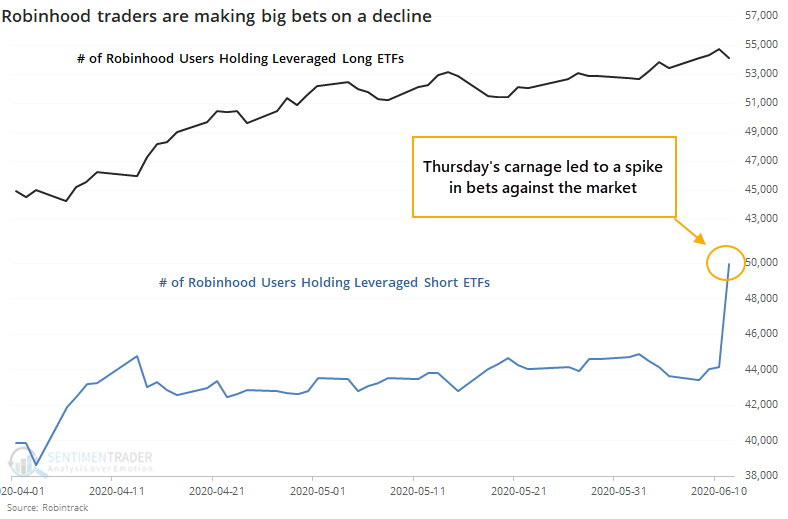
Users of the Robinhood platform used Thursday's carnage to make big bets against more declines in stocks. Users holding leveraged short ETFs exploded by more than 13%, a decent sign of a massive shift in sentiment.

At the end of May, we looked at user behavior among Robinhood account holders. The commission-free platform has become enormously popular during the past couple of months, ostensibly as an outlet for bored gamblers.

At the time, they were showing a modest preference for leveraged long ETFs, maybe a slight negative for stocks. If we check how they behaved during Thursday's rout, we can see a clear change in sentiment.
The data hasn't been around long, and Robinhood's popularity among fast-fingered traders has been a "thing" for an even shorter amount of time, but below we can see the one-day user growth in accounts holding the leveraged long ETFs minus the growth in users holding leveraged short ETFs.
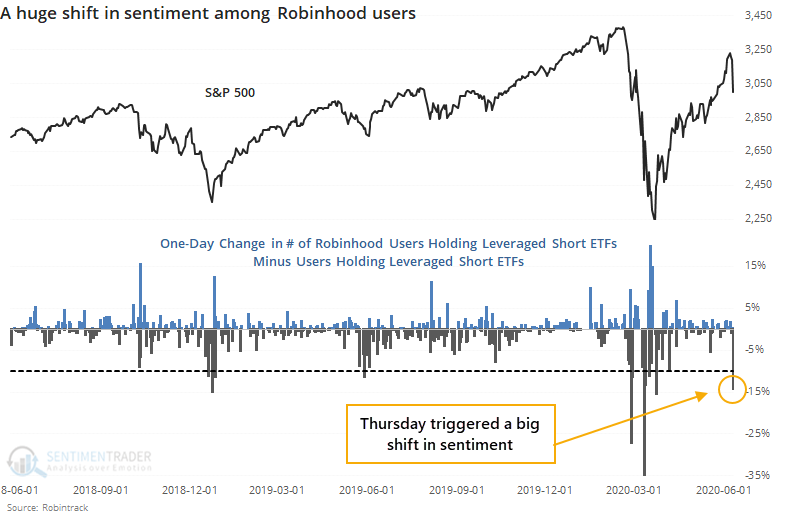
There was a 1.2% drop in users holding the long ETFs and 13.1% rise in users holding the short ETFs, for a net difference of more than 14%, among the largest in two years.

Below we can see the S&P 500's shorter-term returns following any day with at least 10% more growth in short bets vs long bets.
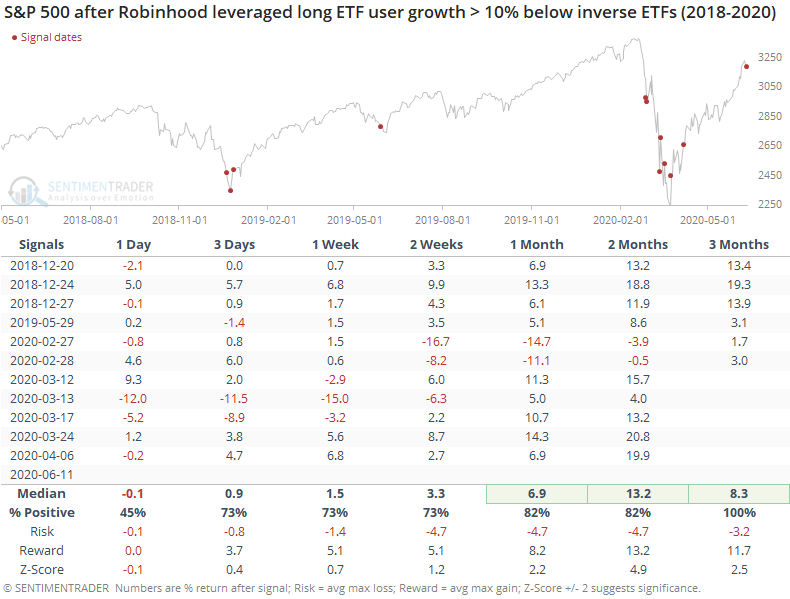
It's not a shocker that this happened during the most volatile stretches in recent years. It was an excellent bottoming signal in 2018 and 2019, but triggered very early in March of this year. Even so, the 2-3 month returns were solid.

Maybe Robinhood will stick around and this can develop into a reliable indicator of retail sentiment. More likely, volatility will pick up, users will move on to their regular jobs and sports betting, and interest in the platform will wane. As it stands, it's a decent reflection of rapidly changing sentiment, and at the moment it suggests that Thursday's panic might be enough to be a decent positive sign over the medium-term.

PRODUCTS
SentimenTrader
Trading Tools
Indicators & Data API
‍
Strategies & Scanner
‍
Research Reports
FREE
RESOUrCES
Simple Backtest
Calculator
Simple Seasonality
Calculator
The Kelly Criterion
Calculator
Sentiment Geo Map
‍
Public Research Reports
‍
Education
Sentiment Indicators
‍
Technical Indicators
‍
Pricing
Bundle pricing
‍
FAQ
‍
Announcements
‍
COMPANY
‍
About
‍
In the News
‍
Testimonials
‍
Client Success Stories
CONTACT
‍
General Inquiries
‍
Media Inquiries
‍
Financial Professionals Inquiries
‍
© 2026 Sundial Capital Research Inc. All rights reserved.
Setsail Marketing
TermsPrivacyAffiliate Program
Risk Disclosure: The information and tools provided are for research and analytical purposes only and are not intended as investment advice. Market analysis involves uncertainty, and outcomes may differ from expectations. Users should conduct their own due diligence and consider their individual circumstances before making any financial decisions. Past performance is not necessarily indicative of future results.

Hypothetical Performance Disclosure: Hypothetical performance results have many inherent limitations, some of which are described below. No representation is being made that any account will or is likely to achieve profits or losses similar to those shown; in fact, there are frequently sharp differences between hypothetical performance results and the actual results subsequently achieved by any particular trading program. One of the limitations of hypothetical performance results is that they are generally prepared with the benefit of hindsight. In addition, hypothetical trading does not involve financial risk, and no hypothetical trading record can completely account for the impact of financial risk of actual trading. for example, the ability to withstand losses or to adhere to a particular trading program in spite of trading losses are material points which can also adversely affect actual trading results. There are numerous other factors related to the markets in general or to the implementation of any specific trading program which cannot be fully accounted for in the preparation of hypothetical performance results and all which can adversely affect trading results.

Testimonial Disclosure: Testimonials appearing on this website may not be representative of other clients or customers and is not a guarantee of future performance or success.